

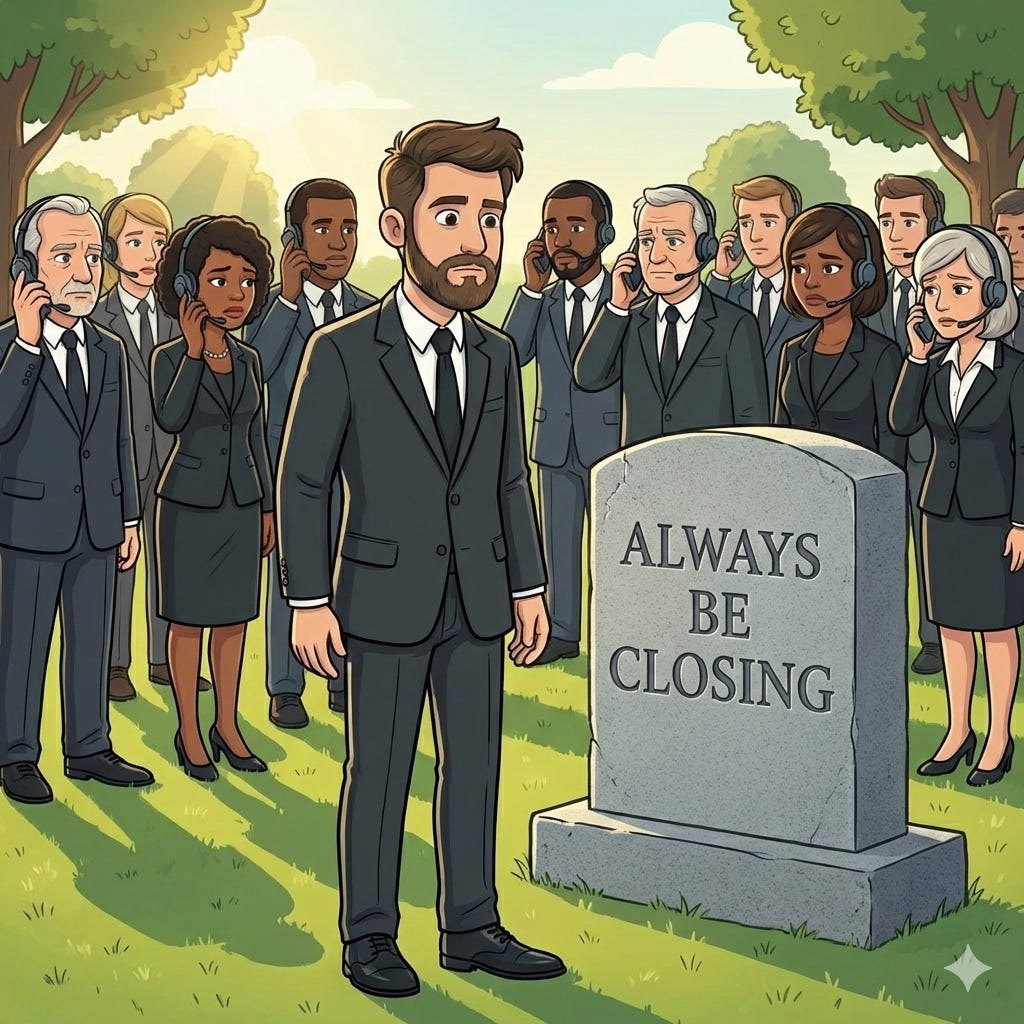
Always Be Closing is dead. Long live ABC.
Provocative title, i know.

Currently auditing our enterprise pipeline - noticed deals that stall past 90 days all have one thing in common: too much push, not enough pull. Testing an agreement-based framework instead.
🎯 THE ONE THING
ABC works. Just not for your deals.
I learned this selling into insurance companies. Complex low-code solution, four stakeholders across IT, procurement, and finance. My manager came from financial services where ABC was gospel - close fast, create urgency, always be pushing.
He wanted to hammer the IT guys. “Let’s get them on a call this week. Push for commitment.”
Problem: These were end-users, not buyers. They weren’t used to sales pressure. One hard push and they’d shut down. I had to physically block my manager from going around me.
The fine line between push and pull? That’s where enterprise deals live or die.
Here’s what nobody tells you about ABC:
It was built for transactional sales. One call, one decision-maker, one close. Financial services, retail, insurance - deals that close in days or weeks.
Your enterprise deal? 20+ calls. Four stakeholders minimum. Six-month cycles.
ABC in that context doesn’t accelerate deals. It kills them.
Lee Salz nails it: “The overarching goal of your first meeting is to pique a high enough level of interest that they want to continue interacting with you after that consultation. Full stop.”
Not to close. To earn the next conversation.
But when you’re under quota pressure, patience feels impossible. So you push. Artificial deadlines. “End of quarter discount.” The buyer smells it. Marcus Chan calls it “commission breath” - when your energy shifts from their needs to yours.
Intelligent buyers don’t just notice. They use it against you. They stall, knowing you’ll sweeten the deal.
The real problem: You’re tracking the wrong thing
Your CRM says “Proposal Sent - 70%.”
But what has the buyer actually committed to?
Do they agree there’s a problem worth solving?
Have they prioritized this over other initiatives?
Did they validate your solution with their team?
Do they believe in the ROI?
Are commercial terms aligned?
Most “70% deals” have activity but zero actual agreements.
In my insurance deal, we had tons of meetings. IT loved the demo. But until procurement validated budget and finance signed off on the business case, we had nothing. Just meetings.
Replace ABC with ABC: Advance By Commitment
Stop asking “What’s the next meeting?” Start asking “Which agreement am I securing?”
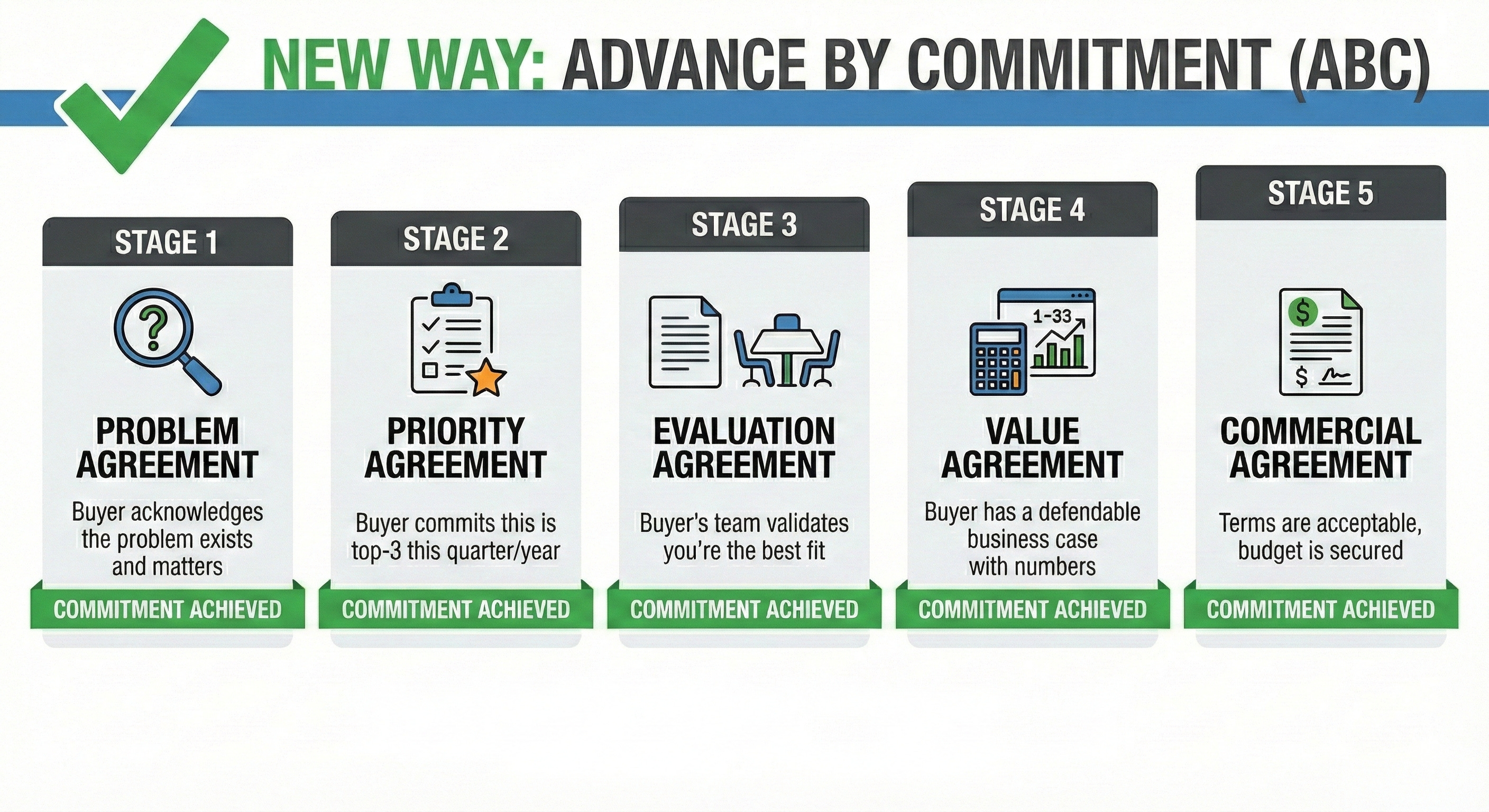
The Five Agreements framework:
Problem Agreement - Buyer acknowledges the problem exists and matters
Priority Agreement - Buyer commits this is top-3 this quarter/year
Evaluation Agreement - Buyer’s team validates you’re the best fit
Value Agreement - Buyer has a defendable business case with numbers
Commercial Agreement - Terms are acceptable, budget is secured
Each agreement is a mini-close. Each requires different stakeholders.
Before every call: “Which agreement am I trying to secure today? What’s my stretch goal if I sense momentum?”
In my insurance deal, IT had Problem and Evaluation locked. But Priority? That lived with finance. Value Agreement? Procurement owned that through their ROI framework.
My manager pushing IT would’ve blown the Evaluation Agreement we’d already secured. But pushing procurement for decision criteria? That moved Priority Agreement forward.
The multi-threaded reality
Enterprise deals aren’t one sale. They’re four separate mini-sales, department by department.
Each stakeholder needs their own sequence. And you’re not in the room for most conversations.
So you equip champions with sound bites they can repeat. Short, memorable phrases that stick when they’re advocating for you.
In my case: “This cuts manual processes by 60% without requiring our developers to write code.” That’s what my IT contact could repeat to finance. Not a 47-slide deck.
Pro Tip: De-risk instead of pressure
When deals stall, reps default to pressure. “We need an answer by Friday.” “This pricing expires end of month.”
Try the opposite.
Brian Neal: “What de-risking does is it tells the buyer how confident you are in what you do. It is de-risking for them, but it has a second purpose - you really believe in your stuff.”
Offer a Day 2 opt-out. A 30-day money-back guarantee. Flexible payment terms. A one-page Implementation Roadmap showing the first 90 days.
The buyer is terrified of making a decision that fails and costs them their job. Your job isn’t to create urgency. It’s to remove fear.
Always Be Closing had it backwards. Advance By Commitment gets it right.
⚡ QUICK WIN
Problem: You don’t know if your deal is progressing or just having meetings.
Solution:
Copy this prompt into Claude/ChatGPT and run it for your top 3 deals:
`You’re helping me audit the real progress of my enterprise deal using the Five Agreements framework (Problem, Priority, Evaluation, Value, Commercial).
Ask me one question at a time about my deal. Wait for my answer before asking the next question.
Start by asking:
What’s the deal? (Company name, solution you’re selling, deal size/length)Who are your key stakeholders? (Names, titles, departments)
Then for each agreement, ask me to describe the evidence I have that this agreement is secured - not assumptions, but actual commitments or documented proof. Adapt your questions based on my specific deal context (industry, stakeholders, deal complexity).
After all five agreements, tell me:
Which agreements are actually secured vs assumedWhich missing agreement is blocking progressOne specific action to secure the next agreement this week`
Why it works:
The LLM adapts questions to your specific deal context and forces you to distinguish between “had a good conversation” and “have documented commitment.” Most reps realize their “70% deal” is actually stuck at Problem Agreement.
Takes 10 minutes per deal. Do your top 3.
📚 READING/LISTENING
New podcast from Patrick Trümpi where he gives us the perspective from the other side of the table. Very tactical and insightful. Good luck for this new podcast.
Try the Five Agreements audit on one stalled deal this week. Which agreement is missing?
What’s your experience with pressure tactics in enterprise deals? Hit reply.
Florian
ABF ;)
This is great! I think the focus on long-term commitment is so important. It kind of reminds me of advice I’ve heard from people like Jordan Peterson and Simon Sinek.
The goal isn’t to win one game. The goal is to win in such a way (and compromise and let the other person win too) so that you continue to be invited to play in future games.